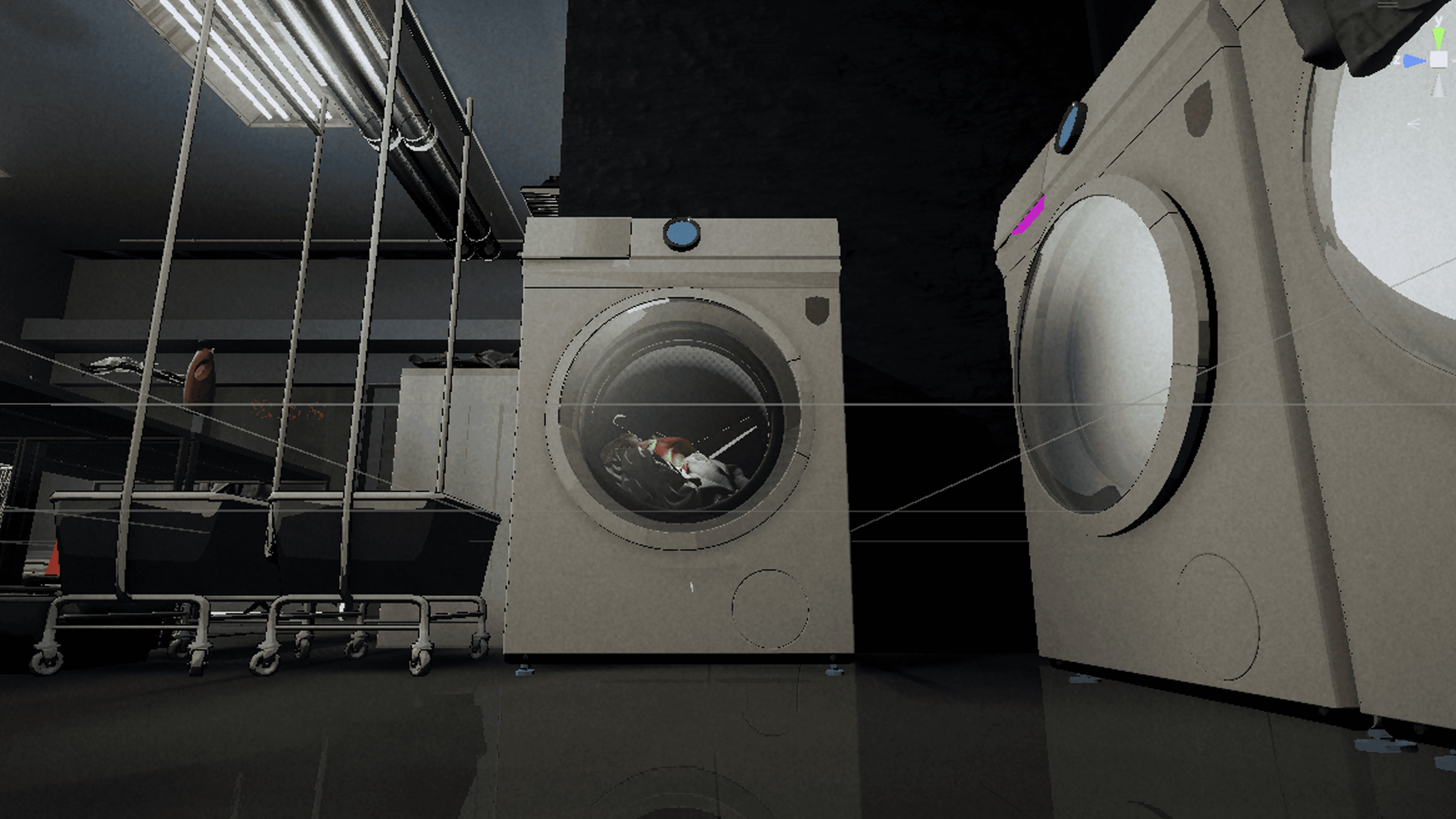
From Non-Place to Place
Designing everyday rituals as interactive experiences.
A first-person interactive experience exploring how routine, repetition, waiting, and environmental continuity can influence how players perceive an ordinary environment.
The Idea
What happens when routine becomes gameplay?
Games often structure engagement around objectives, challenges, rewards, and progression.
From Non-Place to Place explores a different approach: using an everyday ritual as the core interaction.
Instead of moving through an environment to complete objectives, the player spends time performing a familiar routine — collecting, washing, waiting, drying, and folding clothes.
The project investigates whether these repeated interactions can shift an environment from something functional and anonymous into something increasingly familiar to the player.


The Design Question
How do everyday rituals performed through interactive systems influence a player's perception of an ordinary environment?
A second question guided the prototype:
Can routine and repetition foster familiarity with an otherwise ordinary environment?

The Experience
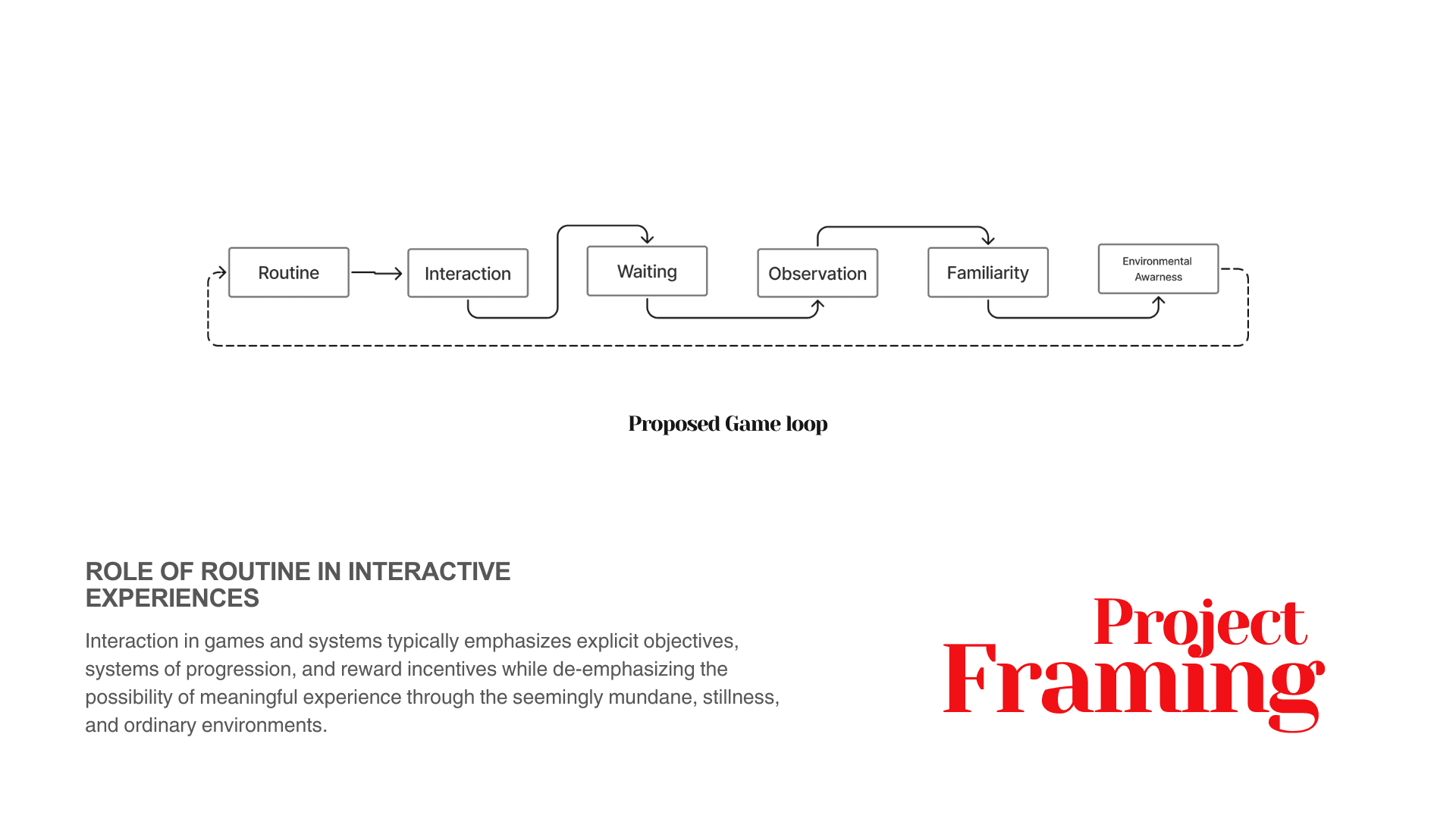
A laundry routine becomes the game loop.
COLLECT → WASH → WAIT → DRY → FOLD
The experience begins in an apartment before moving into the laundromat, allowing the player to transition from a familiar domestic space into a shared, functional environment.
The routine itself provides the structure rather than conventional progression or rewards.
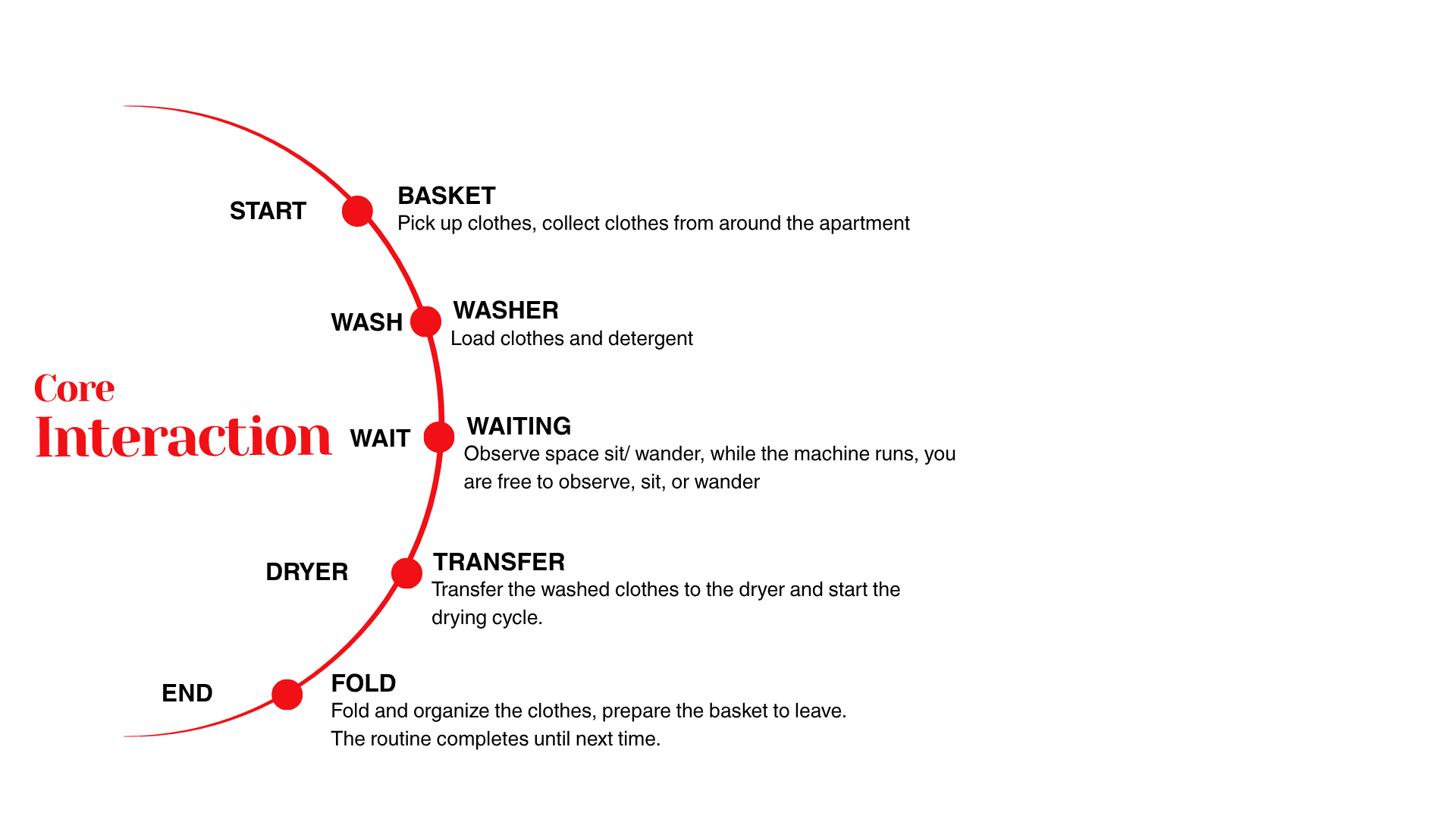
Collect
The player gathers clothes from the apartment and prepares them for washing.
Wash
Clothes, detergent, and the washing machine form a simple physical interaction sequence.
Wait
Machine cycles introduce periods without an immediate objective. These pauses create opportunities to observe the environment.
Dry
The player transfers the clothes and starts another machine cycle, continuing the ritual.
Fold
The routine concludes through sorting and organizing the clothes before leaving the laundromat.
Routine is not an interruption between gameplay moments. It is the gameplay loop itself.
Why a Laundromat?
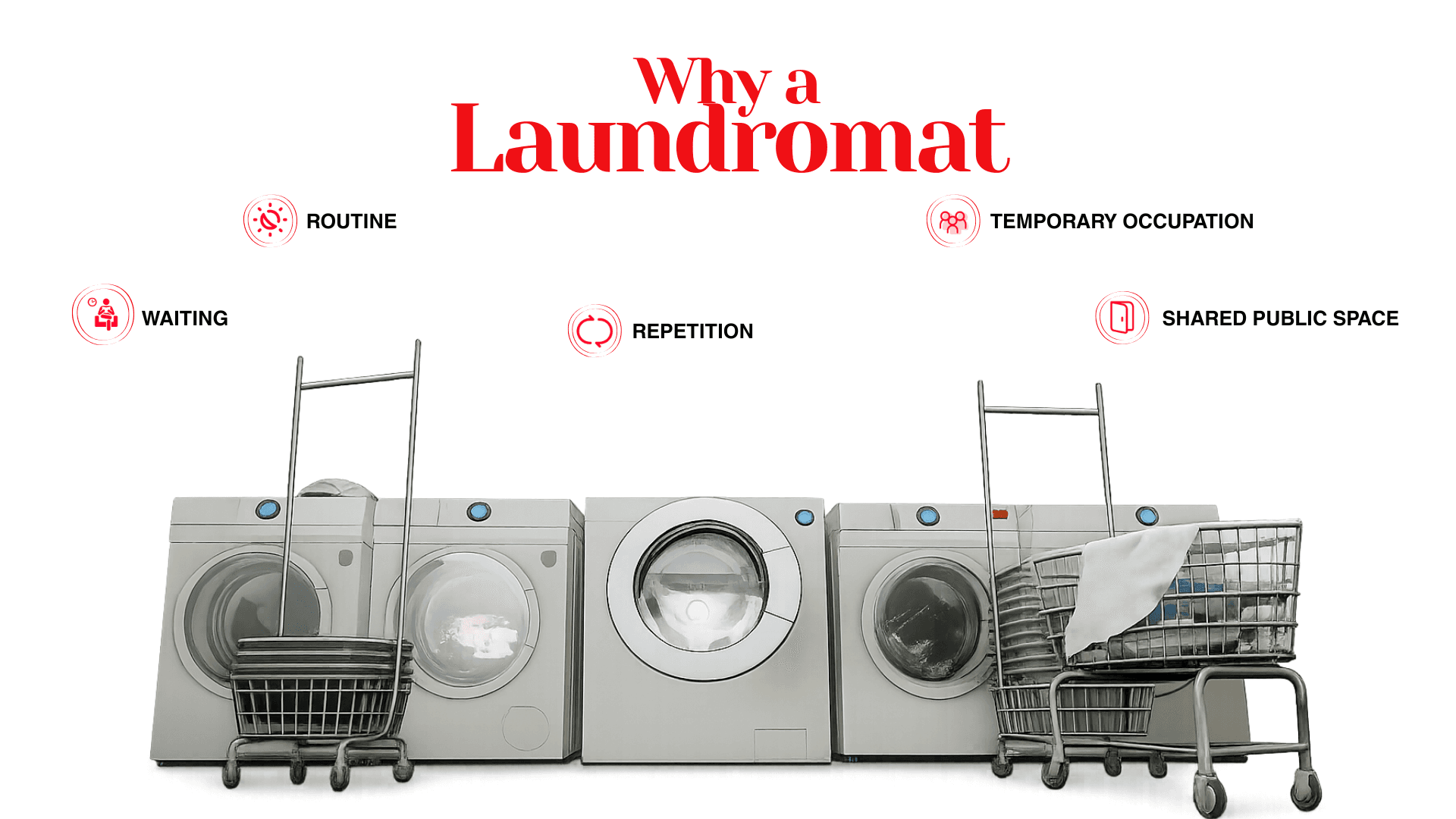
The laundromat was selected as a focused case study because it naturally combines:
ROUTINE
A familiar sequence of repeated actions.
REPETITION
The same environment and interactions are encountered repeatedly.
WAITING
Machine cycles create periods where there is no immediate task to perform.
TEMPORARY OCCUPATION
Players inhabit the space without permanently belonging to it.
SHARED PUBLIC SPACE
The environment is functional, ordinary, and used by different people.
This made the laundromat a useful setting for exploring how interaction can change the perception of an otherwise ordinary environment.
Designing the Environment
The environment was designed to support interaction without relying heavily on explicit instructions.
Waiting & Rhythm
Machine cycles create natural pauses and establish the pace of the experience.
Environmental Affordances
Objects and spatial arrangements communicate possible interactions through their placement, appearance, and accessibility.
Observation
Environmental details and subtle interactions encourage players to look, listen, and explore while waiting.
Ambient Continuity
Lighting, sound, machine rhythms, and recurring environmental elements maintain a sense of continuity within the space.
From Prototype to Experience
The project evolved through several iterations.
VISUAL EXPLORATION
Initial experiments established the visual direction and atmosphere.
↓
RESEARCH REFOCUS
The project shifted toward everyday rituals, ordinary environments, and environmental perception.
↓
PROTOTYPE DEVELOPMENT
The apartment and laundromat became the primary spaces for testing the interaction model.
↓
ITERATION
Visual, interaction, pacing, and environmental systems were refined through development and playtesting.
The focus gradually moved away from making the environment simply look interesting toward designing how players spend time inside it.
Playtesting
What did players actually do?
The prototype was evaluated through sessions with 10 participants, using a combination of:
Observation
Questionnaires
Semi-structured interviews
Interaction logs
Movement heatmaps
Sessions lasted approximately 20–30 minutes and focused on how players performed the routine, behaved during waiting periods, and interacted with the environment.
What I Found
01 Routine extended engagement beyond task completion
Players naturally followed the laundry sequence without explicit instructions, leaving space for observation and interaction with the environment.
02 Waiting encouraged environmental observation
During machine cycles, players used periods of waiting to observe, explore, and interact with details in the environment rather than remaining inactive.
03 Repetition increased familiarity
Repeated encounters with the same spaces, objects, and interactions helped players become more familiar and comfortable with the environment over time.
04 Environmental continuity strengthened presence
Consistent spatial details, ambient systems, and recurring environmental elements helped players perceive the space as continuous and increasingly familiar.
The Design Insight
The playtest suggested a progression:
ROUTINE
↓
REPETITION
↓
FAMILIARITY
↓
ENVIRONMENTAL PERCEPTION
Rather than relying on rewards or progression to sustain engagement, the prototype uses repeated interaction and time spent within an environment as the primary drivers of the experience.
My Role
Game Design
Designed the interaction loop, routine structure, environmental systems, and pacing.
Interaction Design
Designed object interactions and environmental affordances to communicate actions without heavy instruction.
Level / Environment Design
Designed the apartment and laundromat spaces around the player's routine and movement.
Research & Playtesting
Designed the evaluation approach, observed player behaviour, analyzed interaction data, and iterated based on findings.
Implementation
Prototyped and implemented the experience in Unreal Engine.

Current State
The current prototype establishes the core laundry routine, environmental systems, and initial playtesting framework.
Development is ongoing, with further iteration focused on refining the interaction model, environmental continuity, and the relationship between routine and player perception.
Project Reflection
The project began with a question about places, but became an investigation into time.

By slowing down the player's interaction with an ordinary environment, the prototype explores how repeated actions, waiting, and observation can become meaningful parts of play.
From Non-Place to Place is an ongoing exploration of how game design can make the ordinary worth inhabiting.